
Medical Services
From rashes to melanoma, Dermatology at Midtowne is equipped to handle all your
dermatological needs. To help you understand your options, we’ve included descriptions of
some of the most common conditions we treat.
Acne
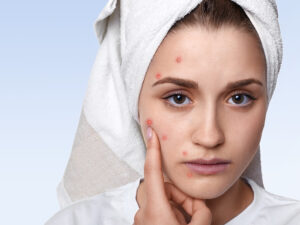
Acne is the most frequent skin condition seen by medical professionals. It consists of pimples
that appear on the face, back, and chest. About 80% of adolescents have some form of acne
and about 5% of adults experience acne. Acne is made up of two types of blemishes:
whiteheads/blackheads and red pustules or papules. Whiteheads/Blackheads are
non-inflammatory and appear more on the face and shoulders. As long as they remain
uninfected, they are more unlikely to lead to scarring. Red pustules or papules are inflamed
pores that fill with pus, which can lead to scarring
Actinic Keratosis
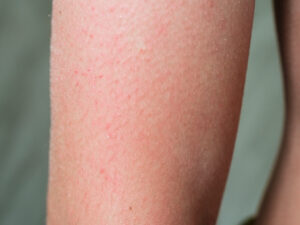
Actinic Keratosis (AK) is a rough dry scaly patch or growth that forms on the skin. An AK forms
when the skin is badly damaged by ultraviolet rays from the sun or indoor tanning. AKs are quite
common and one of the most frequent reasons for seeing a dermatologist. Anyone who has
many AKs should be under a dermatologist’s care. Most people who have multiple AKs continue
to get new AKs. AKs are considered precancerous. Left untreated, AKs may turn into a type of
skin cancer called squamous cell carcinoma. If skin cancer does develop, it can be caught early
when treatment often cures skin cancer.
Hair and Scalp Disorders
Hair loss (Alopecia) can affect just your scalp or your entire body, and it can be temporary or permanent. It can be the result of heredity, hormonal changes, medical conditions or a normal part of aging. Anyone can lose hair on their head, but it’s more common in men.
Baldness typically refers to excessive hair loss from your scalp. Hereditary hair loss with age is the most common cause of baldness. Some people prefer to let their hair loss run its course untreated and unhidden. Others may cover it up with hairstyles, makeup, hats or scarves. And still others choose one of the treatments available to prevent further hair loss or restore growth.

Seborrheic dermatitis
Seborrheic dermatitis is a very common skin disease that causes a rash. When this rash
appears, the skin tends to have a reddish color; swollen and greasy appearance; and/or white
or yellowish crusty scale on the surface. One or more of these rashes can appear on the body.
Sometimes the affected skin itches. Patches usually form where skin is oily (scalp, ears,
eyebrows, center of face, eyelids, etc.).
Alopecia areata
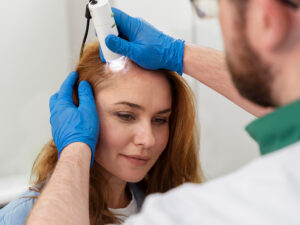
Alopecia areata is a disease that develops when the body attacks its own hair follicles (where
hair grows from), which can cause hair loss anywhere on the body. Many people who develop alopecia areata develop a round or oval bald patch on their scalp. The hair loss tends to be unpredictable. While Alopecia areata often causes hair loss on the scalp, you can have hair loss on any part of your body. Some people develop hair loss on another area of the body, such as eyelashes, eyebrows, or beard. Wherever the hair loss occurs, it happens without any
signs of rash, redness, or scarring.
Hidradenitis Suppurativa
Hidradenitis suppurativa (HS) is a skin condition that causes painful lumps deep in your skin.
These lumps usually develop on parts of the body where skin touches skin like the armpits,
inner thighs, and groin area. It is a non-contagious inflammatory skin condition which requires
specialized treatment.
Infections

Impetigo
Impetigo is a common bacterial skin infection, especially in children. It’s also highly contagious.
Blisters and crusts are common signs of impetigo. Most people get impetigo through skin-to-skin
contact with someone who has it. Staphylococcus and streptococcus bacteria cause the most
cases of impetigo. They can get in through a cut, scratch that barely breaks the skin, or bug
bite. A rash, sore, or burn also provides a great entry point for the bacteria. MRSA is a resistant
form of staph infection which requires more aggressive treatment to prevent recurrence.
Molluscum contagiosum
Molluscum contagiosum is caused by a virus and causes small bumps on the skin that tend to
clear with time. You can get molluscum at any age, but it’s most common in children who are 1
to 10 years old. Children who have atopic dermatitis (often called eczema) tend to get it more
easily and may require a longer treatment course.
Shingles
Shingles is a a painful, blistering rash from a previous chickenpox infection. The varicella zoster
virus that caused the infection remains dormant in your nerves over the years and reactivates
during times of stress or lower immunity as we age. Shingles is treated with an oral antiviral
prescription to provide immediate relief of the painful rash.
Warts (HPV)
Warts (HPV) are small, harmless growths that appear most frequently on the hands and feet.
Sometimes they look flat and smooth, other times they have a dome-shaped or cauliflower-like
appearance. Warts can be surrounded by skin that is either lighter or darker. Warts are caused
by different forms of Human Papillomavirus (HPV). They occur in people of all ages and can
spread from person-to-person and from one part of the body to another. Warts are benign
(noncancerous) and generally painless.
Malignant Melanoma
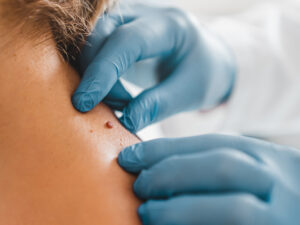
Malignant melanoma is a form of skin cancer. It is often simply called “melanoma”. This skin
cancer can spread quickly. Finding and treating melanoma before it spreads is important. With
an early diagnosis and treatment, melanoma has a high cure rate.
A common warning sign of melanoma is change. Melanoma may start in an existing mole. A
change to the shape, color, or diameter of a mole can be a sign of melanoma. Other changes to
watch for include a mole that becomes painful or begins to bleed or itch. Not all melanomas
start in a mole. Some melanomas begin suddenly on normal skin. A sudden, new growth could
be a melanoma.
Schedule an appointment today!
Moles (Nevi)
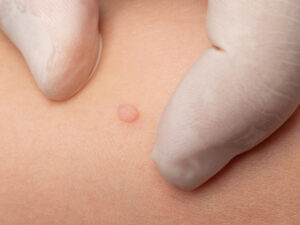
Moles are brown or black growths, usually round or oval, that can appear anywhere on the skin.
They can be rough or smooth, flat or raised, single or in multiples. They occur when cells that
are responsible for skin pigmentation, known as melanocytes, grow in clusters instead of being
spread out across the skin. Generally, moles are less than one-quarter inch in size. Most moles
appear by the age of 20, although some moles may appear later in life.
Nail Disorders

- Splitting or Peeling Nails
- Nail Psoriasis
- Nail discoloration/pigmentation
- Beau’s Lines
- Nail Fungus
- Onycholysis
Pigmentation Disorders
Skin pigmentation disorders affect the coloring of your skin. Your skin gets its color from a
substance called melanin. When cells that produce melanin become damaged, it affects
melanin production. Some pigmentation disorders affect patches of skin, others affect your
entire body. If your body creates an excessive amount of melanin, your skin gets darker, and
vice versa with too little melanin production leading to lighter skin.
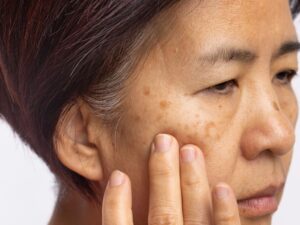
Melasma
Melasma is a skin condition that causes patches and spots, usually on the face, which are
darker than your natural skin tone.
Vitiligo
Vitiligo is a disease that causes areas of skin to lose color, resulting in spots and patches of
lighter skin. Some people develop a few spots. Others have more widespread color loss.
Psoriasis & Psoriatic Arthritis
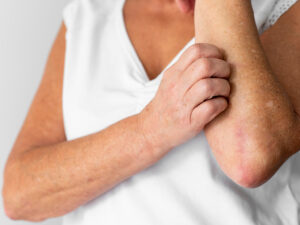
Psoriasis is a condition that causes the body to make new skin cells in days rather than weeks.
As these cells pile up on the surface of the skin, you may see thick, scaly patches. Plaques can
appear anywhere on the skin, but you’re most likely to find them on the knees, elbows, lower
back, and scalp. Plaques tend to vary in size. They may appear on the skin as a single patch or
join together to cover a large area of skin. No matter the size, plaques tend to be itchy. Without
treatment, the itch can become intense. Some people notice that their skin stings, burns, or
feels painful and tight.
Some people who have psoriasis develop a type of arthritis called psoriatic arthritis. The first
sign is frequently swollen, stiff, and sometimes painful joints when waking up. If this happens,
tell a dermatologist right away.
Rosacea
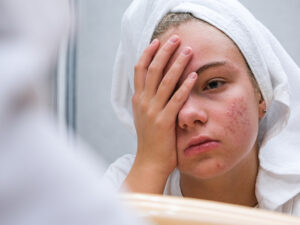
Rosacea is a chronic skin condition that causes facial redness, acne-like pimples, visible small
blood vessels on the face, swelling and/or watery, irritated eyes. This inflammation of the face
can affect the cheeks, nose, chin, forehead or eyelids. Rosacea is treated with topical
prescription medications and facial laser treatment if needed.
Skin Cancers
Skin cancer is the most common form of human cancers affecting more than one million
Americans every year. One in five Americans will develop skin cancer at some point in their
lives. Skin cancers are generally curable if caught early. People who have had skin cancer are
at a higher risk of developing a new skin cancer, which is why regular self-examination and
doctor visits are imperative. The most common warning signs of skin cancer include a new
non-healing bump or growth, a new mole or one that is changing in size, shape, or color.
Basal cell carcinoma (BCC) is the most common type of skin cancer. BCC appears on the skin
in many shapes or sizes. You may see a dome-shaped flesh colored growth with visible blood
vessels; a shiny pinkish patch; or a sore that does not heal completely. BCC rarely spreads to
other areas of the body, but it can grow deep into tissue and bone.

Squamous cell carcinoma (SCC) is the second most common type of skin cancer. SCC appears
on the skin in many shapes. You may see a crusted or rough bump; a red, rough flat patch; a
dome-shaped bump that grows and bleeds; or a sore that does not heal, or heals and returns.
SCC commonly develops on skin that is exposed to the sun, such as the face, ears, lips, back of
the hands, arm and legs. Left untreated, SCC can spread to the lymph nodes or other parts of
the body
Other skin conditions we treat
- Dermatomyositis
- Granuloma annulare
- Hives
- Keratosis Pilaris
- Lichen planus
- Lupus
- Morphea
- Mixed Connective Tissue Disease
- Pityriasis Rosea
- Pemphigus/Bullous Pemphigoid
- Tinea versicolor

